
gold
Gold Hallmarks Explained: How to Verify Your 22ct Gold
Joshua · 20 August 2026
Last updated: 09 Oct 2026
Gold jewellery has long held a special place in South Asian culture. Whether a traditional wedding set, a treasure family heirloom, or a beautifully-crafted piece for everyday wear, it is a symbol of security, good fortune, and heritage.
But, as the saying goes: All that glitters is not gold. To the naked eye, even a gold-plated necklace or ring could look genuine. Gold hallmarks are one of the most reliable ways to verify the authenticity of your gold jewellery. These tiny symbols and numbers reveal important information, including an item’s purity, manufacturer, and the Assay Office who tested it.
Dating back over 700 years, UK hallmarking remains as one of the most respected forms of consumer protection. So, if you’re considering purchasing gold jewellery, either as a gift or to add to your own collection, then read on to find out more!
What is a Gold Hallmark?
A gold hallmark is an official stamp applied to precious metal items such as jewellery, coins, or bullion bars to certify its purity. In the UK, it is a legal requirement to hallmark any piece of gold jewellery that weighs over 1 gram by one of the certified Assay Offices (London, Birmingham, Sheffield, Edinburgh).
To put simply, hallmarks give anyone buying or selling gold additional peace of mind that the item is legitimate as it contains the stated level of pure gold content advertised within the metal, meeting the required standards recognised worldwide.
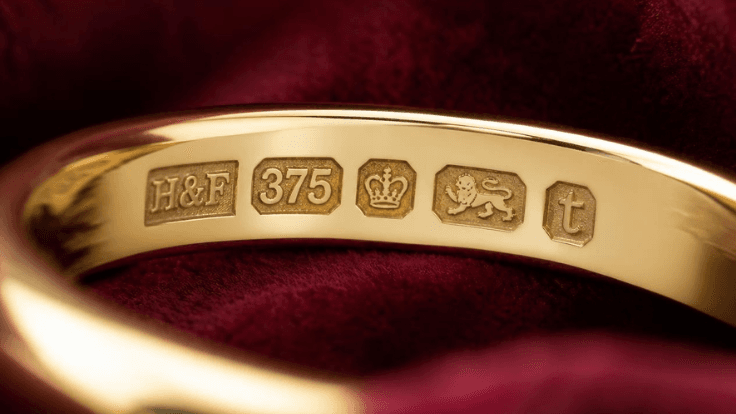
A complete UK gold hallmark includes several components, which are stamped in a horizontal row, including:
A sponsor’s or manufacturer’s mark
The fineness (purity) number
Assay Office symbol
A date letter showing the year of hallmarking (on some pieces)
Gold Purity Numbers Chart
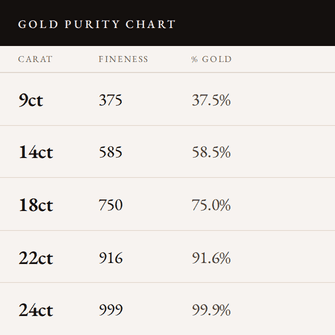
Pure gold is naturally soft. Because of this, it is mixed with other metals to improve a piece of jewellery’s strength, durability and colour. In the UK, gold purity is commonly expressed in carats (ct) and as a fineness number, measured in parts per thousand. The gold hallmark chart below shows the most common fineness stamps:
Last updated: 09 Oct 2026
22ct gold is by far the most common unit for Indian jewellery, consisting of a high 91.6% purity, a rich yellow appearance, and the structural strength needed to craft intricate Indian bridal jewellery, jhumka earrings, mangalsutra chains and delicate filigree work.
Remember, the exact look and combination of gold hallmarks may vary, depending on when and where the piece was tested.
The Assay Offices
Now, let’s explain each of the Assay Offices in more detail. The UK has four official Assay Offices who are responsible for testing and hallmarking precious metals. Each has its own distinctive symbol:
London Assay Office: Established in 1327 by the royal charter, it is the oldest office based at Goldsmiths' Hall in London. Its symbol is a leopard’s head.
Birmingham Assay Office: It is the largest office in the UK, first established in 1773. It uses an anchor as its symbol, which legend has it, was made on the toss of a coin.
Sheffield Assay Office: Operation in Yorkshire since 1773, it is famous for originally hallmarking silverware with a white rose emblem as its symbol.
Edinburgh Assay Office: As the only office in Scotland, it was founded in 1457 and uses a three-towered castle to serve as a historic and visual representation of the city.
Overall, recognising these gold hallmark symbols can help you quickly identify an existing piece of jewellery’s purity and origins. For a trusted point of reference, always read the Assay Office’s official guides to permitted hallmark stamps.
Why Do Hallmarks Matter?
Rather than relying solely on a jeweller’s description, an established hallmark means people will always have a full guarantee of quality. For high-value jewellery, gold hallmarking is especially important as it can help:
Verify a piece’s authenticity.
Identify where the item was tested.
Differentiate between real gold jewellery and imitations.
Buyers make informed decisions.
However, a hallmark alone is not enough to guard against counterfeiting. That’s why it’s vital to spot the tell-tale signs of fake gold hallmarks, which we’ll explore later in this guide.
How to Read Gold Hallmarks on Your Jewellery
So, how do you identify gold hallmarks on a piece of jewellery? The first step is knowing where to look. Because they are very small in size, good lighting is crucial. You can use a lamp, daylight, or even your phone’s flashlight will do the job. To add, a quality magnifying glass or a jeweller's loupe (10x magnification) is best for examining the hallmarks closely.
Where to Find Hallmarks
The location of the hallmarks depend on the type of jewellery. Look carefully for a sequence of tiny symbols and fineness numbers from our purity chart above to help.
Rings:
The hallmarks can be found inside the band of a ring. Look along the inner surface towards the back of the ring. On wider bands, wedding rings, or gents rings, they may be easier to see. Take care to not confuse the hallmark with a jeweller’s setting marks for gemstone rings.
Bangles and bracelets:
Gold hallmarks on bracelets are normally positioned in a discreet location on the inside edge. For solid gold bangles, be sure to check the inner circumference. Sometimes, they can also appear near the hinge, clasp, catch or fastening section.
Necklaces:
On necklaces, the hallmark is often close to the clasp. Check for a small rectangular or oval shaped tag or end plate. For heavier, more elaborate necklaces, it may appear on the reverse of a central decorative section or concealed area.
Earrings:
Hallmarks are the most difficult to find on earrings due to their size. For stud earrings, check the post, butterfly back, or fastening section. Hoop earring hallmarks can be located on the inner curve, whereas drop earrings may have it on the hook or clasp.
Pendants:
With pendants, gold hallmarks are either found on the bail (the small loop through which the chain passes) or the reverse side. Look particularly along the lower edge or on a flat, concealed section. Highly decorative pendants may have the hallmark placed where it will not interrupt the design.
Signs of Fake Gold Hallmarks
Now that you know how to read gold hallmarks, how can you spot the fake ones? While counterfeits have become a lot more sophisticated, fake gold hallmarks leave certain clues behind. Be cautious if you notice the following:
Blurred, soft, or shallow edges: Real hallmarks are cleanly stamped or laser-etched into the metal, leaving sharp, crisp lines. The lines of hallmarks created by fraudsters look rounded, blurred or shallow.
Incorrect or unfamiliar symbols: Make sure the hallmarks correspond with the universally-recognised UK Assay Offices. Crude, distorted or incorrect symbols could suggest your gold is not authentic.
Missing marks: Always check if the fineness number, manufacturer's mark or Assay Office symbol is present on the item before purchasing or valuing gold jewellery.
Deceptive markings: Watch out for GP (Gold Plated), GF (Gold Filled), GE / GEP (Gold Electroplated), or HGP (Heavy Gold Plated). These items are not solid gold.
Discolouration or the “halo” effect: If you notice a faint ring, line, or colour variation around the hallmark, it could indicate a "transference" scam, where a genuine mark has been transferred onto gold-plated base metal.
What if There is no Hallmark?
A missing hallmark does not automatically mean that your gold jewellery is fake. There are plenty of older pieces made before modern hallmarking, or the marks have simply worn away over time.
Very small items such as miniature charms or fine chains that are below the 1 gram threshold are exempt from compulsory hallmarking requirements. If an imported piece was never submitted to a UK Assay Office, this could also be the reason why it is unmarked.
If you do intend to buy a substantial piece of gold jewellery in the UK, the lack of an appropriate marking should prompt further investigation. As professional jewellers, we can test your items using X-ray fluorescence analysis, electronic testing, or acid testing to accurately assess the precious metal’s composition. Avoid home tests, magnets or internet “gold hacks”, as these methods can be misleading and may damage your jewellery.
22ct vs 18ct Gold: Which Should I Choose?
Well, that all depends on how you plan to wear your jewellery.
22ct gold has a 91.6% purity level with a rich warm hue that is highly valued, especially for traditional Indian wedding sets. With a higher content of gold it is softer, and therefore more prone to scratching or bending if worn frequently and handled improperly.
On the other hand, 18ct gold contains 75%, and is generally stronger and more durable out of the two. Because of this, artisans are able to craft more lightweight, intricate pieces using gemstones for everyday wear.
Whichever option you choose, understanding gold hallmarking can help you better appreciate the quality, purity, and provenance of the jewellery you’re buying. For more details, read our latest article on 22ct vs 18ct gold.
Buy Authentic UK Indian Gold Jewellery from Sanjeev
At Sanjeev, you’ll never need to guess whether your gold jewellery is true to its purity. Every ring, necklace, or bracelet is handcrafted in 22ct gold by our skilled artisans right in the heart of Southall, London, accompanied by a certificate of authentication with every purchase.
Combining tradition and contemporary design, we offer breathtakingly pure pieces that stand the test of time. Whether you’re searching for a full bridal set, everyday favourites, or something truly bespoke, our specialists are here to help.
Browse our exquisite collection of Indian gold jewellery, or contact our team for expert advice and support.